Macro Detector - input pattern analyzer
GPADLAB's Macro Detector is an exploratory controller input pattern analyzer. It runs three 10-second trials and reports browser-observed press rate, interval variation, repeated transitions during a hold, and combo timing consistency. The thresholds are GPADLAB heuristics rather than a validated human-versus-macro classifier. A flagged pattern can have several causes, so the tool cannot prove macro use, turbo use, cheating, or innocence.
Compare three input patterns
Trial 1 - Rapid-fire (10 seconds)
The user presses a single button (face button A is recommended) as fast as possible for 10 seconds. The tool records every press and release timestamp at frame resolution and computes the press rate in Hz, the mean interval between presses, the standard deviation of intervals, the coefficient of variation, and the mean press duration. GPADLAB flags very high press rates and very low timing variation as unusual for this guided trial. The thresholds are descriptive heuristics and do not identify the cause of the observed pattern.
Trial 2 - Held-button (10 seconds)
The user holds any button continuously for 10 seconds. A normally functioning controller registers exactly one press event and one release event. Turbo-enabled controllers generate rhythmic on/off pulses while the button is held - typically 10 to 30Hz cycles. The tool measures the total pressed duration, the number of release events that occurred during the held window, and applies autocorrelation-via-coefficient-of-variation analysis to detect rhythmic patterns. A strong rhythmic pattern is flagged for repeat investigation; it is not a turbo verdict.
Trial 3 - Combo (10 seconds)
The user performs a 4-button sequence (A → B → X → Y) five times in 10 seconds. The tool extracts each completed combo, measures the total combo duration and the inter-button gap at each step, and computes the standard deviation across all combos. Very low inter-button timing variation across repeated combos is flagged as highly regular browser-observed input. It is not proof of scripted replay.
Per-trial interpretations with heuristic signal labels
Each sub-test produces a plain-language interpretation with a low, medium, or high heuristic signal label. These labels describe how strongly the browser-observed values cross GPADLAB's internal thresholds; they are not statistical probabilities and have not been calibrated as a forensic classifier.
Copyable plain-text report
The results panel can copy the raw metrics, heuristic interpretation, timestamp, and controller identifier as plain text. The export is useful for reproducing or comparing a setup, but GPADLAB does not present it as tournament evidence, cheating proof, or an enforcement-grade report.
Statistical signature ranges
The ranges below are GPADLAB heuristic reference bands for this browser-based guided test. They are not validated population limits, forensic thresholds, or probabilities, and browser-observed timing can be shaped by the controller, firmware, operating system, browser scheduling, display cadence, remapping software, and user technique.
| Metric | Reference Band | Heuristic Flag |
|---|---|---|
| Press rate (rapid-fire) | 6 to 15 Hz sustained - typical engaged rapid-press | Higher sustained press rates produce a stronger heuristic flag in this guided trial, especially when timing is also unusually regular. Rate alone cannot identify turbo, macro firmware, assistive input, or the user's technique. |
| Coefficient of variation | 0.15 to 0.40 - natural timing jitter | Lower coefficient of variation means the recorded intervals were more regular. Very low variation raises the heuristic signal, but browser scheduling, frame cadence, controller firmware, remapping software, and user technique can all affect this value. |
| Release events during 10s hold | 0 to 1 - expected for a properly functioning controller | Repeated releases during a continuous-hold trial are worth investigating, especially when they form a regular rhythm. Possible causes include turbo behavior, switch bounce, remapping, connection/input artifacts, or an imperfect hold; the browser result does not identify the cause. |
| Combo inter-button gap std dev | 30 to 100 ms - practiced human variation | Lower variation across repeated combos means the observed sequence timing was more regular. Extremely regular timing raises the heuristic signal, but it is not proof of scripted replay and should be interpreted alongside the raw samples and test conditions. |
| Heuristic signal | Low, medium, or high | The signal label summarizes how strongly the observed metrics cross GPADLAB's internal reference thresholds. It is not a probability or calibrated finding of macro or turbo use. |
A regular pattern needs context
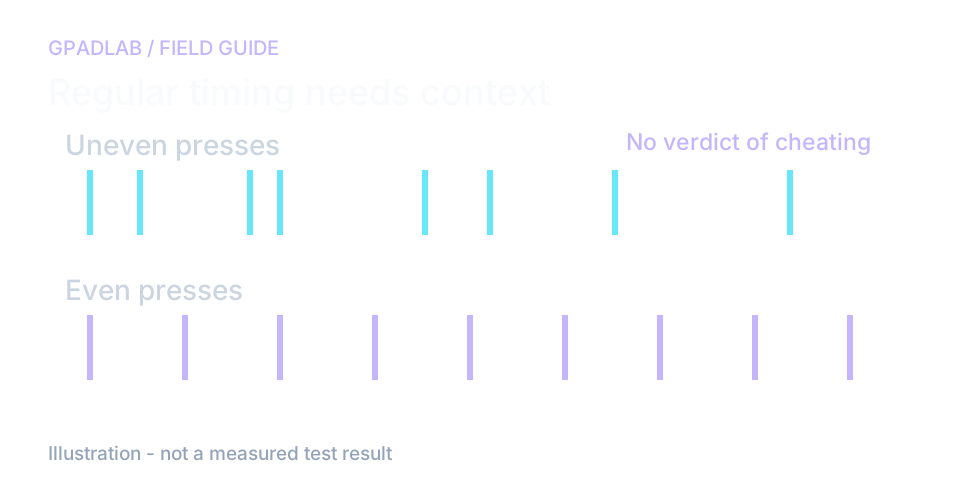
What a flagged trial tells you
A flag means the observed presses crossed a GPADLAB timing rule. It does not prove a macro, turbo feature, or cheating. Fast technique, remapping, duplicate input, and browser sampling can affect the pattern.
Repeat the trial with the same button. Note any controller profiles or turbo settings you know are active.
What to put in a useful report
Record the controller model, connection, browser, and which trial repeated the pattern. Keep the measured values rather than reducing the result to an accusation.
The tool does not identify a Cronus or XIM device from timing alone. It also cannot prove innocence when no pattern is flagged. Use its report to guide a closer check of your own setup.
Compatible controllers
Any controller the browser recognizes as a standard gamepad can be analyzed. The tool measures timing patterns rather than hardware features, so the analysis is consistent across major brands.
Related diagnostics
Macro Detector questions
No. The tool identifies patterns inconsistent with typical human input - it cannot definitively prove that any specific behavior was the result of cheating, firmware modification, or assistive input. Skilled humans can produce statistics that overlap with macro firmware on some metrics. Certain games introduce timing artifacts that mimic highly regular patterns. The output is a signature for investigation, not a verdict. Use the report as one piece of evidence in a process that includes context, history, and judgment - never as a sole basis for accusation.
It is useful for players, testers, repairers, content creators, accessibility users, and tournament or esports staff who want to inspect repeatable browser-observed timing patterns. It is not a compliance system and should not be used as the sole basis for a ruling, accusation, or claim that a controller is macro-free.
Because a "Human Plausibility Score" being shared on social media is dangerous. Either people brag about being human (strange) or about being suspicious (which fashion-codes cheating). And a shareable image with a verdict label is the perfect tool for false accusations. We made a deliberate choice to break the pattern from our other tests here - this tool serves a different audience with different needs. The output is functional data, not viral content.
GPADLAB does not publish a validated detection-accuracy percentage for this tool. It reports timing-pattern heuristics from browser-observed data. Strong rhythmic or highly regular patterns may be worth repeating and investigating, but the same pattern can have more than one cause, so the tool cannot establish macro use, turbo use, cheating, or innocence.
A very fast or unusually regular trial can raise the heuristic signal. That does not mean the tool has identified cheating or automation. Review the raw press rate and timing variation, repeat the trial under the same conditions, and treat the flag as a pattern to inspect rather than a verdict.
The tool can flag a regular pulsing pattern when that pattern is visible in the browser-observed input stream, regardless of whether turbo is allowed in a particular context. It does not determine whether a feature is legal, permitted by tournament rules, or actually produced by turbo firmware.
Not reliably. The browser sees the resulting controller input stream, not a trustworthy identifier for the upstream device or its configuration. The tool may flag unusually regular timing that happens to be present, but it cannot determine that a Cronus Zen, XIM, or similar adapter caused the pattern.
No. All input capture and analysis happens locally in your browser tab. Nothing is sent to a server, nothing is stored across sessions, and the report exists only in your browser until you copy it or close the tab. The report you copy is a plain-text string in your clipboard - share it where you choose to.
How we analyze input patterns
Three ten-second trials record press rate, held-button transitions, and combo timing. GPADLAB rules flag unusual patterns for closer review. They are not validated human-versus-macro limits. Browser timing, user technique, firmware, and remapping can affect the result. No flag proves cheating, and a clean run does not prove innocence.Dedicated methodology article not yet published; see the methodology hub for the methods currently available.