Last updated: August 20, 2026
Tunnel Magnetoresistance (TMR) joysticks are becoming one of the most important upgrades in modern game controllers.
For years, controllers changed slowly. A new console generation might bring a revised shell, stronger vibration, another share button or a different D-pad, but the basic machinery underneath remained familiar. Analog sticks still relied heavily on potentiometers. Face buttons still used rubber membranes. Polling rates were rarely something ordinary players discussed.
That is changing quickly.
TMR joysticks are now appearing in performance-focused controllers. 1000Hz polling has spread well beyond expensive esports hardware. Some PC controllers are pushing headline rates as high as 8000Hz. Mechanical, optical and hybrid tactile switches are replacing conventional membrane inputs in some designs. Triggers can behave like a full analog accelerator in one game and a short-click input in another.
The important question is not whether these specifications exist.
It is whether they actually improve control, accuracy, durability and responsiveness in ways players can measure.
TMR does not make every controller perfectly accurate. An 8000Hz badge does not make total input latency eight times lower than 1000Hz. And calling a controller "anti-drift" does not mean every moving part inside its joystick has become immune to wear.
So what do Tunnel Magnetoresistance joysticks actually change, and which other controller upgrades matter alongside them?
What Are Tunnel Magnetoresistance (TMR) Joysticks?
Traditional analog sticks commonly determine position using potentiometers.
Inside a potentiometer-based stick, physical electrical contact is involved as the mechanism moves across a resistive element. With enough use, wear, contamination and changes in the resistive components can alter the signal around the neutral position. That is one of the mechanisms associated with the stick drift players have dealt with for years.
Hall Effect joysticks changed that equation by using magnetic sensing instead of relying on the same type of contacting position sensor.
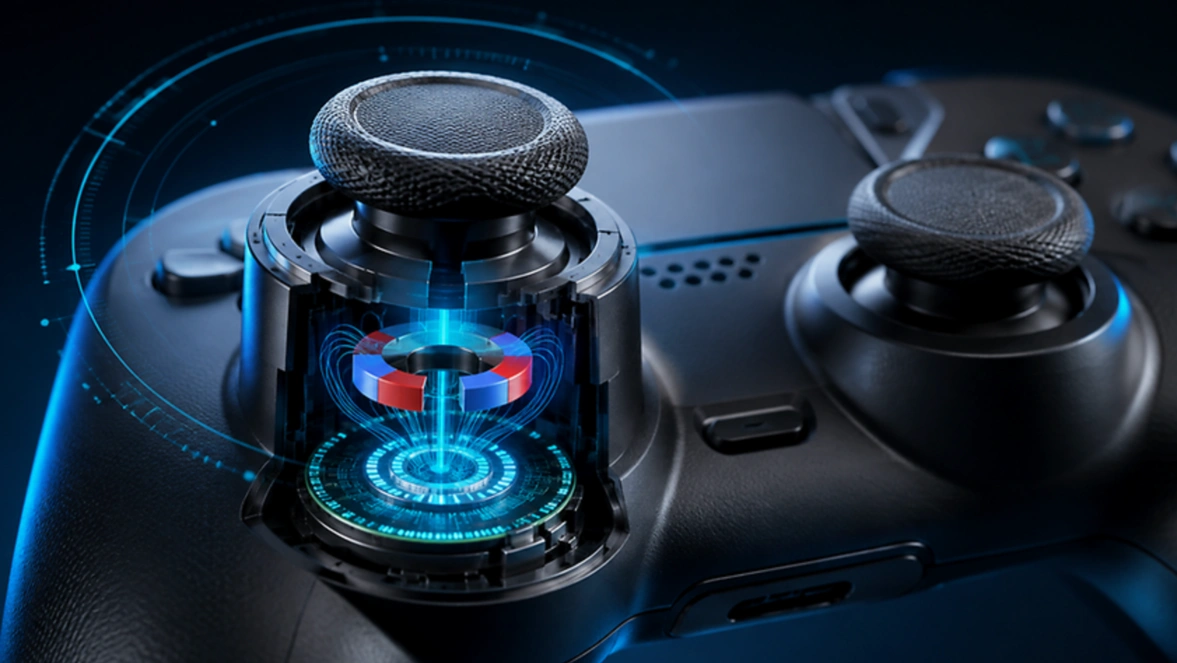
Tunnel Magnetoresistance, usually shortened to TMR, is another magnetic sensing technology.
A TMR sensor detects changes in a magnetic field through corresponding changes in electrical resistance. As TDK's technical explanation of TMR sensing describes, the technology uses the tunnel magnetoresistive effect to produce a comparatively large resistance change when the magnetic field changes.
For a joystick, the practical benefit is straightforward: stick position can be measured magnetically without depending on the same type of sliding electrical contact used in a traditional potentiometer.
TMR sensing can also offer high magnetic sensitivity, which is one reason the technology is attractive for compact position-sensing systems.
That does not mean every TMR joystick automatically beats every Hall Effect joystick.
A good Hall Effect controller can still deliver excellent performance. The quality of the complete stick module, magnet geometry, calibration, ADC implementation, firmware, deadzone configuration, response curve and mechanical design can matter more than the sensor acronym printed on the box.
TMR is better understood as the newest major development in the magnetic-stick movement, not proof that every TMR controller is automatically superior.
TMR Joysticks vs Hall Effect Joysticks
TMR and Hall Effect joysticks are often grouped together because both avoid the conventional sliding resistive contact used by potentiometer sticks.
That similarity matters.
Both technologies can reduce dependence on one of the wear mechanisms commonly associated with traditional analog-stick drift.
The difference is in how the magnetic field is sensed.
Hall sensors generate a voltage response related to the magnetic field. TMR sensors use changes in resistance produced by the tunnel magnetoresistive effect.
At the sensor level, TMR technology can provide high magnetic sensitivity. In a controller, however, sensor sensitivity is only one part of the system.
A controller can use an excellent sensor and still perform poorly because of:
- excessive factory deadzones,
- weak centering mechanics,
- poor calibration,
- aggressive firmware filtering,
- nonlinear response curves,
- low-quality stick housings,
- inconsistent wireless behavior,
- or bad software configuration.
That is why a TMR badge should be treated as a promising hardware feature rather than a guarantee of perfect stick performance.
Controllers including the 8BitDo Ultimate 2 Wireless, GameSir G7 Pro and Razer Wolverine V3 Pro 8K PC now use TMR thumbsticks.
The important shift is not just that TMR exists. It is that the technology is moving from enthusiast discussion into mainstream performance-controller marketing and product design.
Do TMR Joysticks Eliminate Stick Drift?
This is where controller marketing often becomes too confident.
Magnetic sensing can remove a major wear mechanism responsible for conventional potentiometer drift. That is genuinely valuable.
It does not make the entire joystick physically immune to every possible problem.
The stick still contains moving components. Springs can change. Centering mechanisms can develop play. Plastic components can wear. Calibration can be poor. Firmware can introduce unwanted deadzones or incorrect response curves. A controller can avoid resistive-sensor wear and still develop bad stick behavior for another reason.
So when a controller advertises TMR or Hall Effect sticks, the useful question is not simply:
"Can this controller drift?"
A better set of questions is:
- How stable is the center position?
- How much resting noise exists?
- How accurately does the stick track around its full range?
- How large is the factory deadzone?
- Does the stick return consistently to center?
- Is the response curve genuinely linear?
- Does performance remain consistent after extended use?
That is why sensor technology should be the beginning of controller testing, not the end of it.
TMR Joysticks Still Need Good Calibration and Mechanics
The strongest argument for TMR can become misleading if the rest of the controller is ignored.
A joystick is a complete mechanical and electronic system.
The sensing element matters, but so do the spring, gimbal, housing tolerances, magnet positioning, ADC, firmware processing and calibration routine.
For example, a highly sensitive TMR sensor may be able to detect extremely small movements around center. If the controller firmware applies a large inner deadzone, much of that additional sensing capability near neutral may never reach the game.
Likewise, a high-resolution analog-to-digital converter can represent many input steps, but those steps do not guarantee that the stick is accurately following the player's physical movement.
This is why measured behavior matters more than the marketing label.
The Polling-Rate Race Has Reached Controllers
Stick sensing is only one part of the current controller technology race.
Polling rate describes how frequently a controller reports its input state to the host system.
The basic relationship is straightforward:
- 125Hz: roughly 8 milliseconds between reports
- 250Hz: roughly 4 milliseconds
- 1000Hz: roughly 1 millisecond
- 8000Hz: roughly 0.125 milliseconds
Polling intervals are part of the way USB Human Interface Devices communicate with a host, and the USB-IF HID specifications define the underlying framework used by USB input devices.
That progression explains why 1000Hz polling has become such a common performance specification.
Several modern performance controllers advertise 1000Hz operation, while some PC-focused models have pushed the headline rate as high as 8000Hz.
The number sounds enormous because numerically it is.
But polling rate is also one of the easiest controller specifications to misunderstand.
GPadLab's Controller Polling Rate Test can be used to examine browser-observed Gamepad API update timing and consistency. Because browser sampling may be constrained by the rendering loop, display refresh rate and browser implementation, the result should be treated as a software-side observed update rate rather than direct certification of a controller's native 1000Hz or 8000Hz USB polling specification.
8000Hz Does Not Mean Eight Times Less Total Input Lag
Going from 125Hz to 1000Hz cuts the maximum interval between reports dramatically.
Going from 1000Hz to 8000Hz reduces that interval again, but now the comparison is approximately 1 millisecond versus 0.125 milliseconds.
The theoretical difference is less than one millisecond.
And controller polling is only one part of the complete input chain.
Your physical input still has to be:
- detected by the controller,
- processed by its firmware,
- transmitted to the PC or console,
- processed by the game,
- incorporated into a rendered frame,
- and displayed by the monitor or television.
A controller advertising 8000Hz can therefore still perform poorly if firmware, transport or internal processing adds delay.
Likewise, a well-designed 1000Hz controller can feel exceptionally responsive.
The higher number gives the system more opportunities to receive fresh input. It does not eliminate every other source of latency.
There is another limitation: the game and display have their own timing.
At 60 frames per second, a new frame arrives approximately every 16.7 milliseconds. At 120fps it is around 8.3 milliseconds. At 240fps it is around 4.2 milliseconds.
That does not make high controller polling useless. It means the improvement has to be considered as one part of a larger latency system.
The jump from slow polling to a stable 1000Hz implementation can be meaningful, particularly for competitive gaming.
Beyond that, the returns become increasingly marginal.
An 8000Hz controller is technically impressive. Whether a particular player gains a meaningful advantage over a strong 1000Hz design is a harder question than the specification sheet suggests.
Buttons Are Starting to Feel More Like Gaming Mice
Analog sticks are not the only part of the controller changing.
Traditional controller face buttons frequently use rubber membranes. Press the button, the membrane collapses, electrical contact is made and the input registers.
The design is cheap, familiar and comfortable, but it can also feel softer than the switches used in gaming mice and mechanical keyboards.
Performance controllers are increasingly experimenting with alternatives.
Some use microswitch-based tactile buttons. Others use optical switches or hybrid designs intended to combine a sharper actuation point with some of the cushioning associated with conventional controller buttons.
The result is not simply "lower latency."
Feel matters too.
A clear actuation point gives the player stronger feedback that an input happened. Shorter travel can make repeated presses easier. Mechanical or optical switches can also produce a more defined click instead of the softer response associated with a traditional membrane.
The comparison with gaming mice is relevant because mouse switches have their own switch-behavior problems, including unwanted duplicate inputs and contact-related faults.
GPadLab's Mouse Button Test can check button registration and flag unusually rapid or duplicated click patterns, providing a useful software-side reference for switch behavior across gaming peripherals.
That does not mean a clickier controller button is automatically better.
Someone playing a fighting game may value a crisp, clearly defined D-pad. A player spending hours inside a relaxed RPG may prefer quieter, softer buttons.
The technology is changing because manufacturers no longer assume one button mechanism should suit every player and every genre.
Triggers Are Becoming Two Inputs in One
The same shift is happening with triggers.
A racing game needs analog travel.
Trigger position can represent partial throttle or partial braking, so removing that range would make the controller worse.
A competitive shooter has a completely different requirement. The player may want the trigger to activate almost instantly.
Modern controllers increasingly solve that conflict with dual-mode trigger designs.
Some controllers combine Hall Effect analog trigger sensing with physical trigger stops or microswitch-based short-actuation modes.
That means the same physical trigger can behave more like a pedal for a racing game and more like a mouse button for a first-person shooter.
This is arguably a more useful innovation than simply increasing a headline specification because the benefit changes according to what the player is actually doing.
Third-Party Controllers Are Forcing the Pace
The unusual part of this controller generation is where much of the experimentation is happening.
Third-party manufacturers are aggressively competing on:
- TMR joysticks,
- Hall Effect sensors,
- polling rates,
- switch design,
- trigger modes,
- rear controls,
- software configuration,
- and connectivity.
The major console manufacturers have generally moved more cautiously.
Microsoft's Elite Series 2 remains focused on features such as adjustable-tension thumbsticks, interchangeable components, paddles and hair-trigger locks.
Sony took a different approach with the DualSense Edge. Its stick modules are replaceable, meaning a worn or faulty module can be removed instead of replacing the entire controller.
Nintendo's newer controller designs have introduced additional controls and usability features, but the wider TMR and ultra-high-polling race has largely been driven elsewhere.
That creates an interesting reversal.
Buying the controller made by the company that built your console no longer necessarily gets you the most advanced stick sensor or the highest polling specification available.
First-party controllers still have major strengths. Native compatibility, haptics, firmware integration, wireless reliability and game-specific features can matter more than raw specifications.
But third-party companies are putting pressure on the old assumption that the official controller should automatically set the technical standard.
Higher Joystick Resolution Does Not Automatically Mean Better Accuracy
There is another number appearing frequently alongside Tunnel Magnetoresistance joysticks: joystick resolution.
Manufacturers may advertise thousands of input levels or high-bit ADCs.
Again, bigger can be better, but only if the rest of the controller makes good use of the data.
Imagine a sensor capable of detecting extremely small stick movements while the controller firmware applies a large inner deadzone.
Those additional measurements near the center are now largely irrelevant.
The same problem occurs if the response curve is badly tuned, the stick has excessive mechanical play or software heavily filters the raw signal.
Resolution tells you how finely a controller can represent an input.
Accuracy tells you how closely that representation corresponds to where you actually moved the stick.
Those are not the same thing.
TMR on the Specification Sheet Is Not Enough
This is the larger problem created by the current controller technology race.
Two controllers can both advertise TMR joysticks and behave differently.
Two can both claim 1000Hz polling and produce different latency or reporting consistency.
A controller can advertise almost zero deadzone while producing poor centering.
Another can have superb raw sticks but ship with firmware that changes their response.
The label identifies the technology.
Measurement tells you how well it was implemented.
That distinction is becoming more important as controller boxes fill with terms such as:
TMR. Hall Effect. 12-bit. 1000Hz. 2000Hz. 8000Hz. Optical. Mechanical. Anti-drift. Low latency.
None of those specifications should be ignored.
None should be trusted in isolation either.
If a controller advertises precise sticks, check center stability, deadzone and circularity.
If it claims better connectivity, test for jitter and dropouts.
If two controllers use the same sensor technology, do not assume they will produce the same results.
And if a controller advertises a very high polling rate, distinguish between the manufacturer's native-device specification and the update timing that browser software can actually observe.
That is the direction controller testing now needs to go.
Are Tunnel Magnetoresistance (TMR) Joysticks Worth It?
For most buyers, a well-implemented TMR joystick is a meaningful upgrade over a conventional potentiometer-based design if long-term resistance to sensor wear matters.
That does not mean you should buy a controller simply because "TMR" appears on the box.
Start with the sticks, but evaluate the whole implementation.
Look for stable centering, sensible deadzones, predictable response curves and good mechanical feel.
Then look at actual input performance rather than chasing the largest polling number available. A stable 1000Hz implementation is already extremely fast. An 8000Hz controller is technically ahead, but the real-world improvement over a strong 1000Hz design is much smaller than the eight-times-larger number suggests.
After that, consider the controls you actually use.
Mechanical or optical face buttons can be excellent if you like strong tactile feedback. Dual-mode triggers make sense if you move between shooters and racing games. Rear buttons matter if they allow you to keep both thumbs on the sticks. Good software matters if the controller lets you adjust curves, deadzones and mappings without fighting the configuration utility.
Compatibility matters just as much.
The world's fastest PC controller is useless to somebody who needs native PlayStation support.
And finally, test what you bought.
The newest generation of controllers is giving players better hardware than ever before, but it is also giving manufacturers more numbers to advertise.
Tunnel Magnetoresistance (TMR) joysticks are one of the most promising changes in that generation, but implementation still matters more than the acronym.
The controller with the biggest number on the box is not automatically the best controller.
The better question is whether the hardware actually delivers when it is in your hands.
Common questions
What are Tunnel Magnetoresistance (TMR) joysticks?+
Are TMR joysticks better than Hall Effect joysticks?+
Do TMR joysticks eliminate stick drift?+
How do TMR joysticks work?+
What is controller polling rate?+
Is 1000Hz polling good for a controller?+
Is 8000Hz eight times faster than 1000Hz in real gameplay?+
How can I test a controller's polling behavior?+
Why are controller buttons becoming more like gaming mouse buttons?+
Are microswitch controller buttons always better?+
What are dual-mode controller triggers?+
Does a higher joystick resolution always mean better accuracy?+
Why are third-party controllers adopting new technology faster?+
Should I choose a controller based only on its specifications?+
What should I prioritize when buying a modern controller?+
Founder of GPADLAB and the lead author behind our testing methodology. Twelve years building consumer hardware diagnostics and a long-time competitive shooter on PC.