Hall Effect Checker - check your stick sensor evidence
A browser Hall effect checker cannot directly read the physical stick sensor technology from the standard Gamepad API. GPADLAB therefore combines a controller-ID match against known Hall-effect models with an optional 3-second resting-noise check and 5-second circularity sweep. A known-model match can support the product specification; behavioral results on unknown controllers are Hall/TMR-like or potentiometer-like evidence only and are not proof of the underlying sensor type.
Check the model and its stick behavior
Connect your controller
Plug in via USB or pair over Bluetooth. Press any button to expose the controller to the page. As soon as the controller is detected, the tester reads its name via the Gamepad API and runs an instant ID match.
ID matching against known Hall models
The tester checks the controller name against a maintained list of specific models or families known to use Hall-effect sticks. A match is product-database evidence, not a sensor measurement from the browser, and contributes one evidence point. Broad brand-only matching is avoided where multiple stick technologies may exist.
Optional resting-noise measurement
Phase 1 is a 3-second resting measurement. If at least 95% of samples remain under the 0.005 heuristic noise threshold, GPADLAB marks the behavior as Hall-like. A clean potentiometer can also meet this threshold, while Hall or TMR sticks can miss it because of calibration, firmware, deadzones, centering, or wear.
Optional circularity measurement
Phase 2 is a 5-second rim sweep. GPADLAB marks circularity under 4% with at least 60% angular coverage as Hall-like behavior for this heuristic. Circularity is also affected by stick mechanics, calibration, firmware shaping, deadzones, and user sweep quality, so it cannot identify sensor technology by itself.
Composite evidence result
Each positive signal contributes one point to a 0-3 evidence meter. A known Hall model plus matching behavior receives the strongest result. A model match alone or two Hall-like behavioral signals produces Hall-Like Evidence. Mixed or untested unknown controllers are Inconclusive. Two missed behavioral thresholds with no model match are described only as Potentiometer-Like Behavior, not as proof of a potentiometer sensor.
What the verdict means
The result summarizes evidence; it does not directly read the physical sensor type from an unknown controller. Known-model ID matches can support a product specification, while resting-noise and circularity measurements are behavioral heuristics.
| Verdict | Trigger | What It Means |
|---|---|---|
| Known Hall Model + Matching Behavior | Known-model ID + ≥1 Hall-like behavior | The model ID matches GPADLAB's known Hall list and the sweep produced supporting behavior. The model match is the sensor-specification evidence; the browser cannot directly inspect the stick hardware. |
| Hall-Like Evidence | Known-model ID OR both behavioral thresholds met | A known Hall model matched, or the unknown controller behaved like a clean magnetic-stick implementation in both heuristic checks. Behavioral evidence alone cannot distinguish Hall effect from TMR or a well-performing potentiometer. |
| Inconclusive | Unknown ID, mixed signals, or no behavioral data | The browser does not have enough evidence to identify the sensor technology. Verify the exact model specification, manufacturer documentation, or a trusted teardown/part number if hardware-level identification matters. |
| Potentiometer-Like Behavior | No known Hall ID + both behavioral thresholds missed | The sweep did not show the Hall-like behavior used by this heuristic. That can be consistent with a potentiometer, but calibration, firmware, deadzones, processing, wear, and user technique can produce the same result. |
What a Hall effect tester can actually confirm
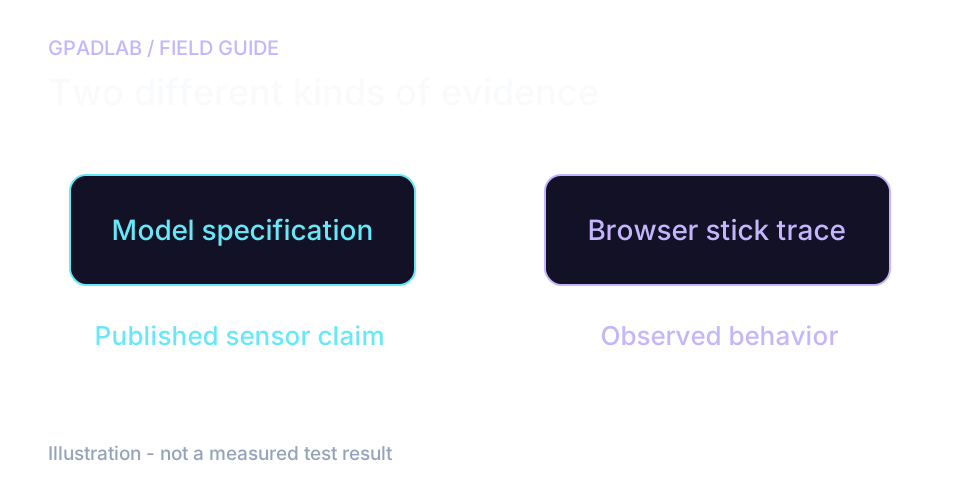
Start with the exact model and revision
A controller name can help match a published specification. Check the full model and revision, especially if several versions share a name. A replacement stick module may differ from the original.
A browser ID match supports a lookup. It does not inspect the sensor fitted inside your controller.
Use the movement tests to check behavior
Low resting noise and a round sweep describe the output seen here. Settings and calibration can also affect those results. They do not prove the use of Hall effect or TMR sensors.
If the result is unknown, check the maker's specification or repair record. Do not open a working controller just to resolve a browser label.
Auto-detected Hall controllers
The ID matcher can recognize selected controller models whose Hall-effect specification is already known. Other controllers receive behavioral evidence only; GPADLAB does not infer an unknown sensor type from brand name alone.
Common next steps
Related diagnostics
Hall Effect Checker questions
A Hall-effect stick uses magnetic sensing to determine stick position instead of reading position through a resistive contact track. This removes the potentiometer track as one common wear source, but the controller still has springs, pivots, magnets, calibration, firmware, and other mechanical/electronic elements that can produce offset or drift. Hall-effect sticks are more resistant to contact-track wear, not immune to every failure mode.
It cannot directly identify the sensor technology of an unknown controller through the standard Gamepad API. GPADLAB can match a sufficiently specific controller ID against a maintained known-model list. The optional resting-noise and circularity checks add behavioral evidence, but clean behavior is not unique to Hall effect: TMR sticks and good potentiometers can look similar, while Hall sticks can look worse because of calibration, firmware, deadzones, mechanics, or wear.
Hall-effect sticks are used in many third-party controller models, including specific GuliKit KingKong/KK, 8BitDo Hall, Flydigi, Razer, Nacon, and BIGBIG WON variants. Stick technology can change between revisions and similarly named models, and TMR is now another magnetic-stick option, so verify the exact model or hardware revision rather than assuming a whole brand uses one sensor type.
They can be worthwhile when resistance to potentiometer-track wear is important, but Hall-effect sticks are not automatically better in every controller. Centering mechanics, firmware filtering, deadzones, resolution, latency, calibration, and overall controller quality still matter. Compare the complete controller rather than choosing only by sensor label.
TMR (tunnel magnetoresistance) is another magnetic sensing technology used in some modern stick modules. Like Hall-effect sensing, it avoids the potentiometer's resistive position track. Sensor sensitivity can differ between Hall and TMR implementations, but the final stick resolution, filtering, deadzone, polling behavior, and accuracy also depend on the controller's ADC, firmware, mechanics, and calibration. This browser sweep cannot distinguish Hall from TMR by behavior alone.
Yes, for most popular controllers. Replacement Hall-effect modules exist for the DualSense, DualSense Edge, Xbox Series X controller, Xbox Elite Series 2, Joy-Con (both halves), and Switch Pro Controller. Costs run $15-30 per stick module, plus your own labor - installation requires opening the controller and soldering or socket-replacing the original module. iFixit and YouTube have step-by-step guides. Skill level: intermediate.
Manufacturers do not publish a single reason that applies to every controller generation. Cost, supply chain, module size, calibration, firmware, power, existing designs, reliability targets, and production tooling can all influence sensor choice. GPADLAB does not infer a manufacturer's internal cost-benefit decision without a documented source.
Inconclusive means the browser evidence is insufficient or mixed. First verify the exact controller model and hardware revision against manufacturer specifications or a trusted teardown. If you inspect the hardware directly, use a verified module part number or teardown reference rather than assuming that a particular stamp, housing shape, or visible magnet always identifies the sensor technology.
How we assess Hall-effect evidence
The page matches the controller ID against a model list and offers rest-noise and rim-sweep checks. The Gamepad API does not reveal the physical sensor type. Behavior on an unknown model cannot prove Hall effect, TMR, or a contact sensor. Check the exact model specification and any repair history.Dedicated methodology article not yet published; see the methodology hub for the methods currently available.
Run the GPADLAB Controller Health Score
The Controller Benchmark combines six core diagnostic stages into GPADLAB's site-defined composite score. Use the stage breakdown for diagnosis and the score for repeat comparison.
Run the Benchmark